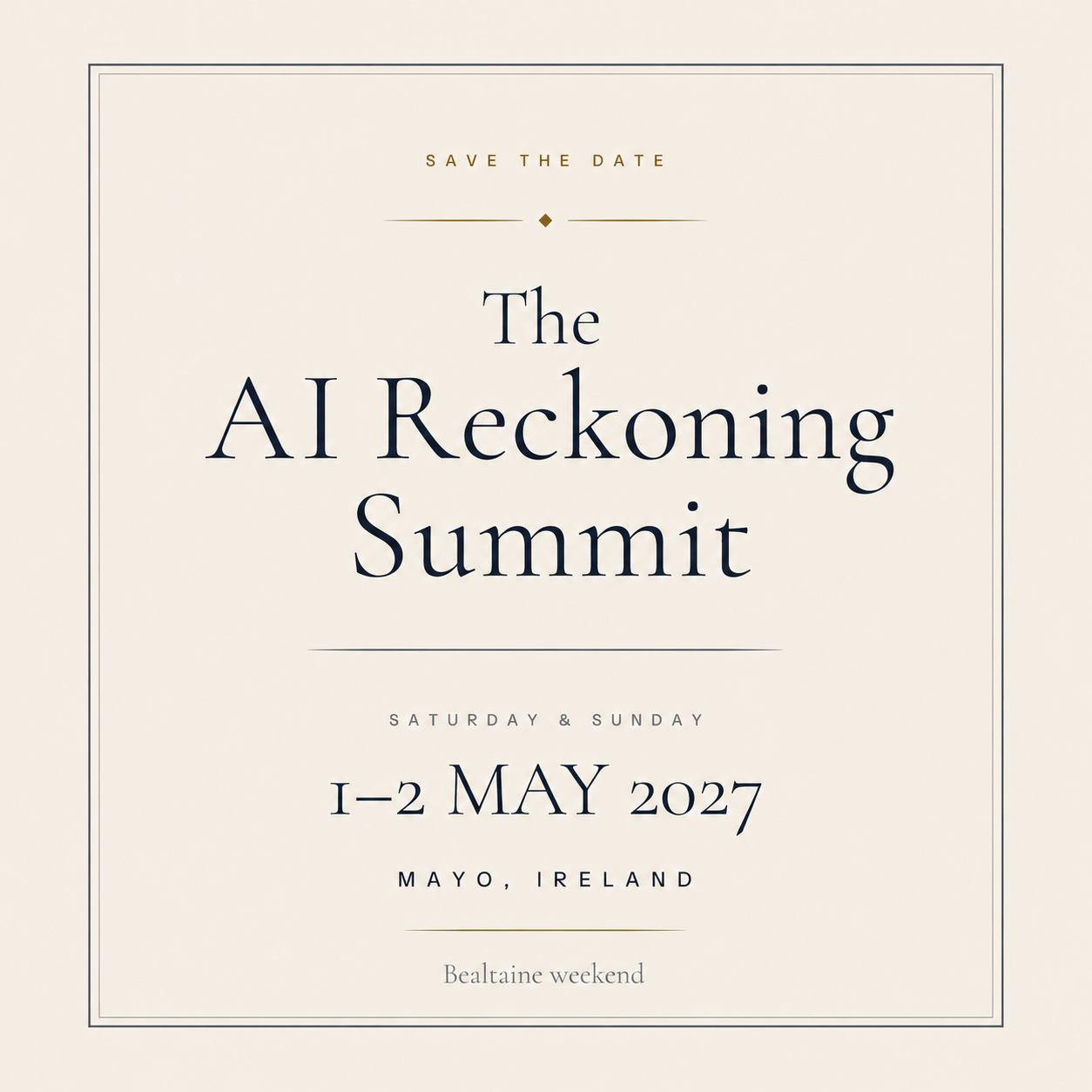
 The AI Reckoning Summit
1–2 May 2027
The AI Reckoning Summit
1–2 May 2027
The AI Reckoning Summit
1–2 May 2027
The AI Reckoning Summit
1–2 May 2027
The people who built this technology are the ones saying it is close. Two of them won Nobel Prizes in 2024 for the work that made it possible.
Geoffrey HintonNobel Prize in Physics, 2024. Turing Award, 2018.
"My guess is in between five and 20 years from now, there's a good chance, a 50% chance, we'll get AI smarter than us."
Official Nobel Prize interview, 6 December 2024
Demis HassabisNobel Prize in Chemistry, 2024. CEO, Google DeepMind.
"I think we're five to ten years away from that."
On AGI, which he defines as "a system that can exhibit all the cognitive capabilities humans can, and I mean all". Big Technology Podcast, January 2026
Yoshua BengioTuring Award, 2018. Chair, International AI Safety Report.
"If you look at the curve that I showed, it would take about five years to reach human level."
TED, April 2025
Ray KurzweilPredicted 2029 in 1999, and has refused to move it.
"I have not revised and not redefined my prediction of AGI, still defined as AI that can perform any cognitive task an educated human can."
His date remains 2029. Statement published in full by his best-known critic, June 2024
Dario AmodeiCEO, Anthropic.
"powerful AI could be as little as 1–2 years away, although it could also be considerably further out."
The Adolescence of Technology, January 2026
They did not always think this. In May 2023 Hinton described his own change of mind: "I thought for a long time that we were, like, 30 to 50 years away from that. So I call that far away from something that's got greater general intelligence than a person. Now, I think we may be much closer, maybe only five years away from that."1
The field moved with him. In the largest survey of its kind, 2,778 researchers who publish in top AI venues put a 50 percent chance on machines outperforming humans at every possible task by 2047. That was thirteen years earlier than the same survey found one year before.2
What is already measured. On GPQA Diamond, a set of graduate-level science questions, people who hold or are studying for a PhD in the relevant field score 65 percent.3 The leading systems now score around 94 percent.4 In July 2025 a Google DeepMind system reached a gold-medal score at the International Mathematical Olympiad.5
And where it is not true yet. On ARC-AGI-3, humans solve 100 percent of the environments. As of March 2026, frontier systems scored below 1 percent.6 Yann LeCun, who shared the 2018 Turing Award with Hinton and Bengio, argues that within five years we might at best be convinced we are on a good path towards human intelligence, and not yet there.7
Nobody can hand you the date, and I am not going to pretend otherwise. But the people closest to the work put it inside our working lives, and that is enough to make the question urgent rather than academic.
Current as of 8 August 2026
What should we dig into?
Sign in once with Google. Your RSVP opens straight after.
1–2 May 2027 · Mayo, Ireland
Sign in with Google so we know who you are and you can change your answer later. Nothing is posted anywhere.